
Local history instead of a catalogue attraction
A catalogue playground or a standard figure looks the same in every town. A place with its own story becomes a meeting point, a backdrop for photos and a reason to visit. We show how we turn local history into landmarks, play spaces and trails.
Why a catalogue does not build identity
We are not a manufacturer of catalogue playgrounds. For us, even a bench, a shelter or a play element is part of one story and one place. A piece bought from a catalogue may be perfectly adequate, but it rarely makes anyone associate it with a particular town.
A well-designed public piece does not belong to one person. Children grow up next to it, families take photos by it, tourists get to know the town through it, and residents begin to connect it with their own identity.
The projects we value most are the ones that take on a life of their own after opening: they become meeting places, landmarks and an image guests take home with them.
Where to find the story
Polish towns, villages, waterfronts and parks have legends, coats of arms, rivers, lakes, old routes and the people who shaped them. The starting point can be a historical figure, an animal, a natural feature, architecture, industrial history or a forest.
We do not simply enlarge logos and mascots. We interpret identity spatially: a local griffin does not have to be a giant figure. It can leave traces in the landscape, a nest, play elements, hidden details and sculptural seating. The story should be discovered, not read off an information board.
A good exercise is to ask residents what their town is known for and what has been forgotten. The most interesting motif often never makes it into the tourist brochure: an old mill, a river crossing, a local legend or a person who changed the history of the place.
Landmark: the image guests take home
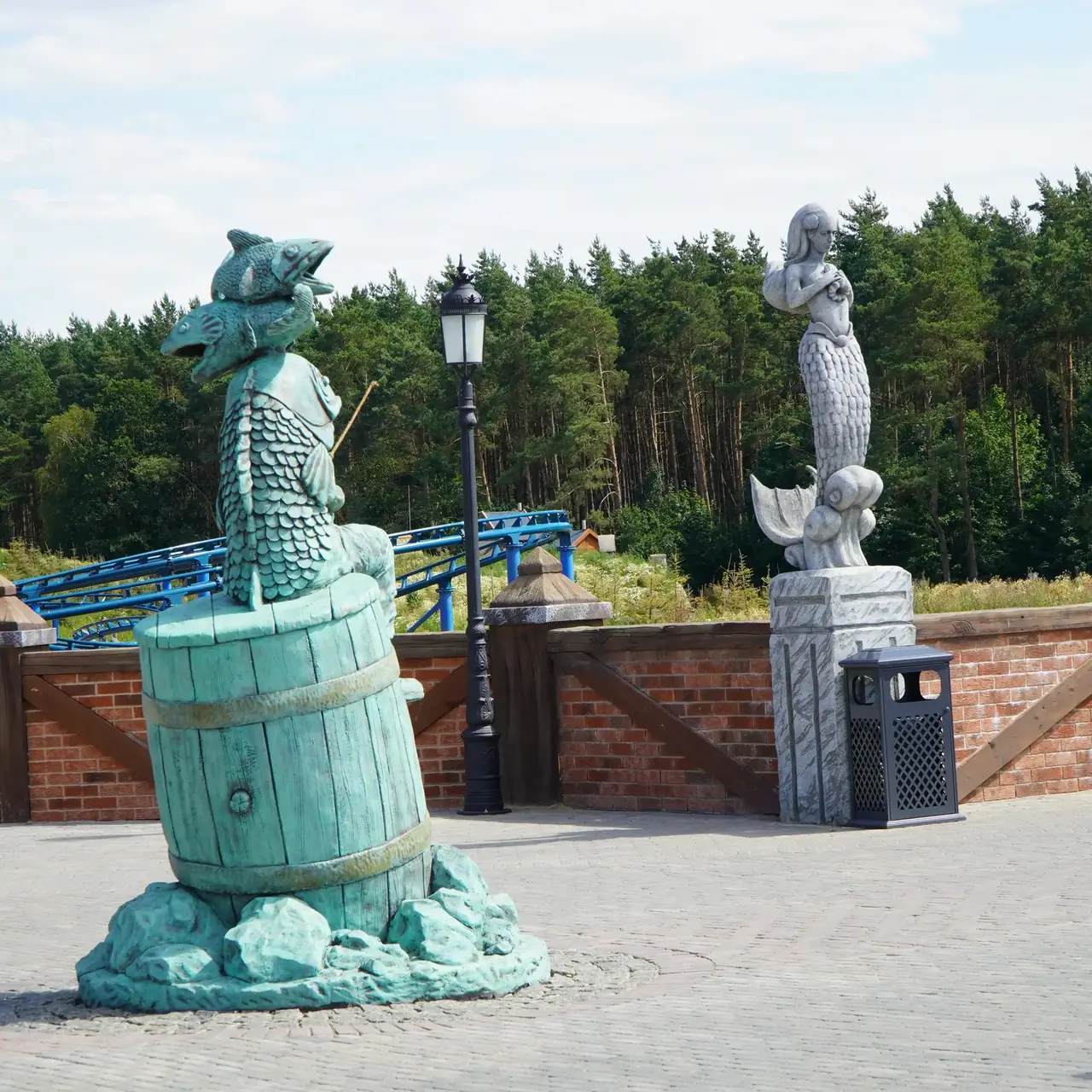
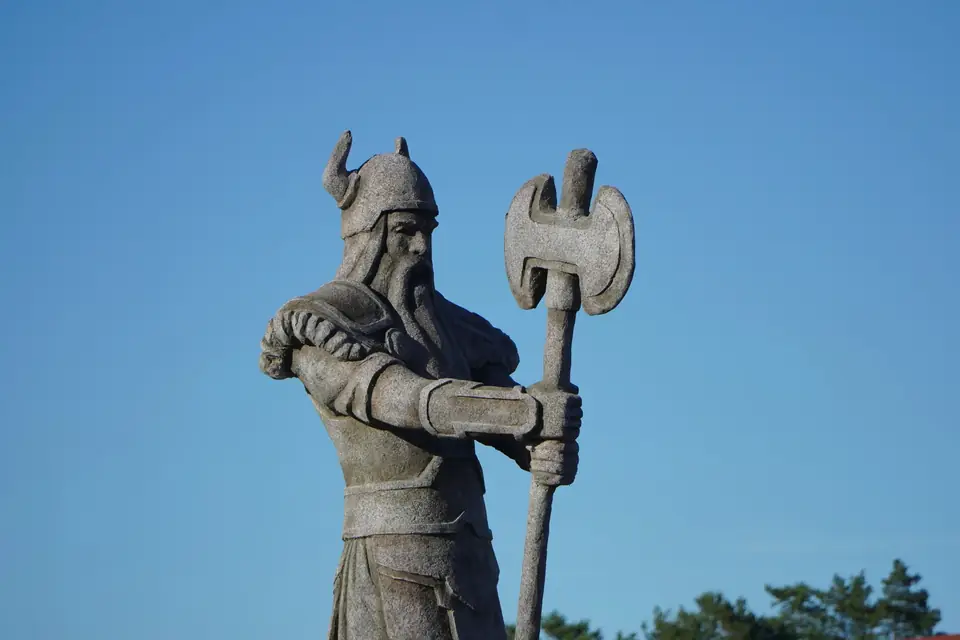
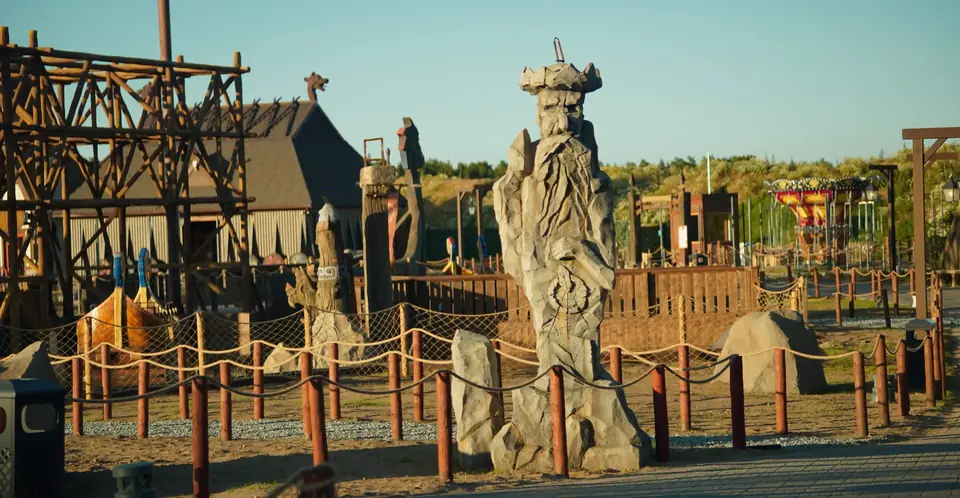
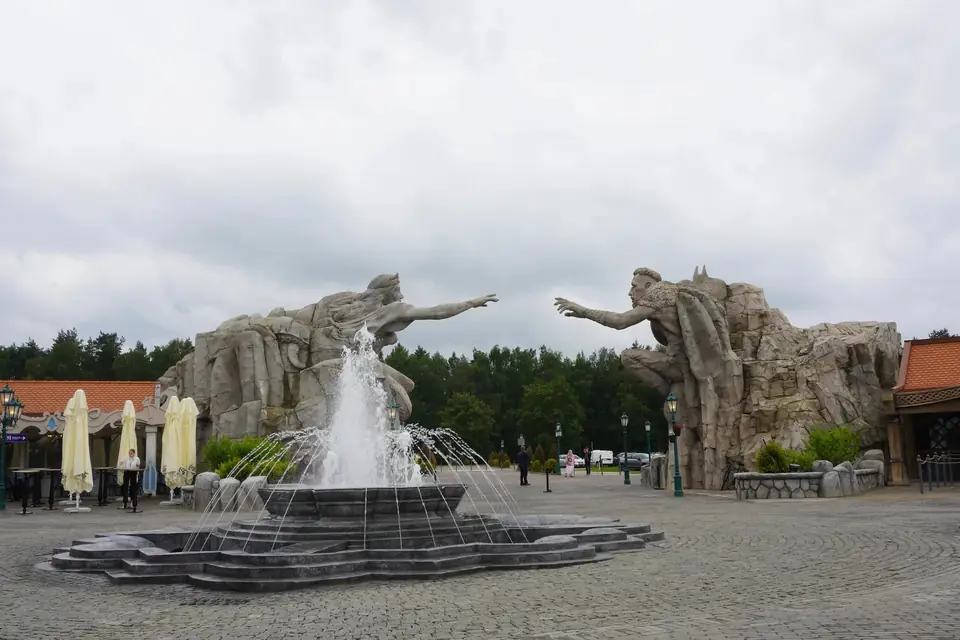
A landmark works when it is at once a point of orientation, a meeting place and a backdrop for photos. At Hossoland, the fisherman figure at the centre of the plaza plays this role as one of visitors' favourite photo spots, while two monumental Druid Sentinels turn an ordinary path into a gateway to the next world of the park.
The same logic works in a municipality: an entrance sign that tells the story of the town, a sculpture on the waterfront or a viewpoint with its own character. The first impression becomes the first memory.
A landmark does not have to be huge. A sculptural bench, a photo spot or a small play piece in a well-chosen location can have more impact than a large figure placed at random. What matters is the connection to the place and whether people have a reason to stop by it.
A play space that tells a story
Play can tell the story of a town. Rocks, tree trunks and traces of animals and legends that children can climb and discover teach more than an information board. Functional sculpture combines form with use: seating, shelters, tables and structures integrated into the sculpture.
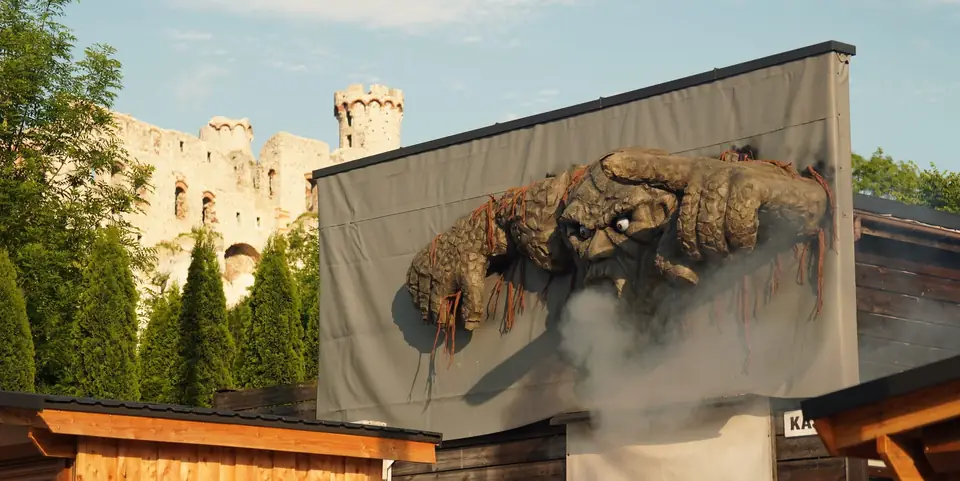
Scenery can also turn a simple attraction into an adventure. Along the Deadwood Drift ride, giant deadwood forms and artificial rockwork turned a children's ride into something families remember and photograph. Technical requirements, standards and procurement procedures are agreed individually for each project.
A trail: a series of pieces instead of one monument
A series of pieces spread across a municipality links it into a single route. In the concept for the Rewal municipality, each motif has its own source, date or memory, and a shared material language creates a single brand for the coast. In the concept for a restaurant in Pobierowo, a single motif, a black cat, leads guests from the promenade and beach access paths all the way to the entrance.
Both works have concept status and have not been built. In the concept proposal for the City Park in Trzebiatów, also unbuilt, surviving relics become the starting point for contemporary forms that do not pretend to be historic.
A trail has one more advantage: it can be built in phases. The first piece tests the language of form and materials, the following ones add new chapters to the same story, and the municipality spreads the investment over time.
Durability and safety from the first sketch
A piece in a public space must withstand weather, daily use and sometimes vandalism. That is why, from the first sketch, we take into account structural design, weather resistance, ease of repair and a maintenance plan. We do not make temporary props.
The story must not overshadow the function either. A play element must be safe, a seat comfortable, and a landmark visible and well lit. We design with accessibility, shade and rest in mind, and confirm technical parameters and required approvals for each location.
Questions and answers
Can you design an entrance sign for a town?
Yes. We make entrance signs, totems, signposts and photo spots tied to local history, based on a sketch, a brand book or just an idea.
Can a sculpture in a public space be functional?
Yes. We design sculptures that double as benches, shelters or play elements. Safety, accessibility and easy maintenance are considered from the first sketch.
Have the concepts shown for municipalities been built?
Not all of them. Each concept card has a clear status: completed, concept, in development or proposal. A concept shows a direction, not a finished piece.
More articles
Knowledge →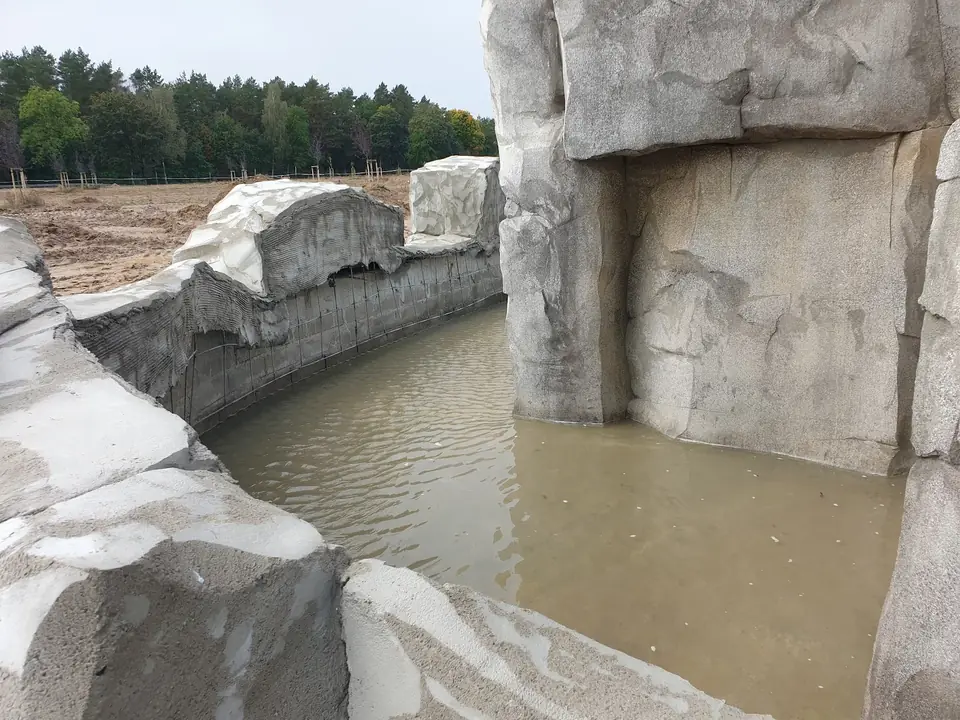
Do you have a complex themed or sculptural package to deliver?
Send drawings, visualisations or a short description. We review every brief and reply with a concrete next step.
Architects and general contractors: Send the project documents