
Restoring historic facade details: Morabyrån
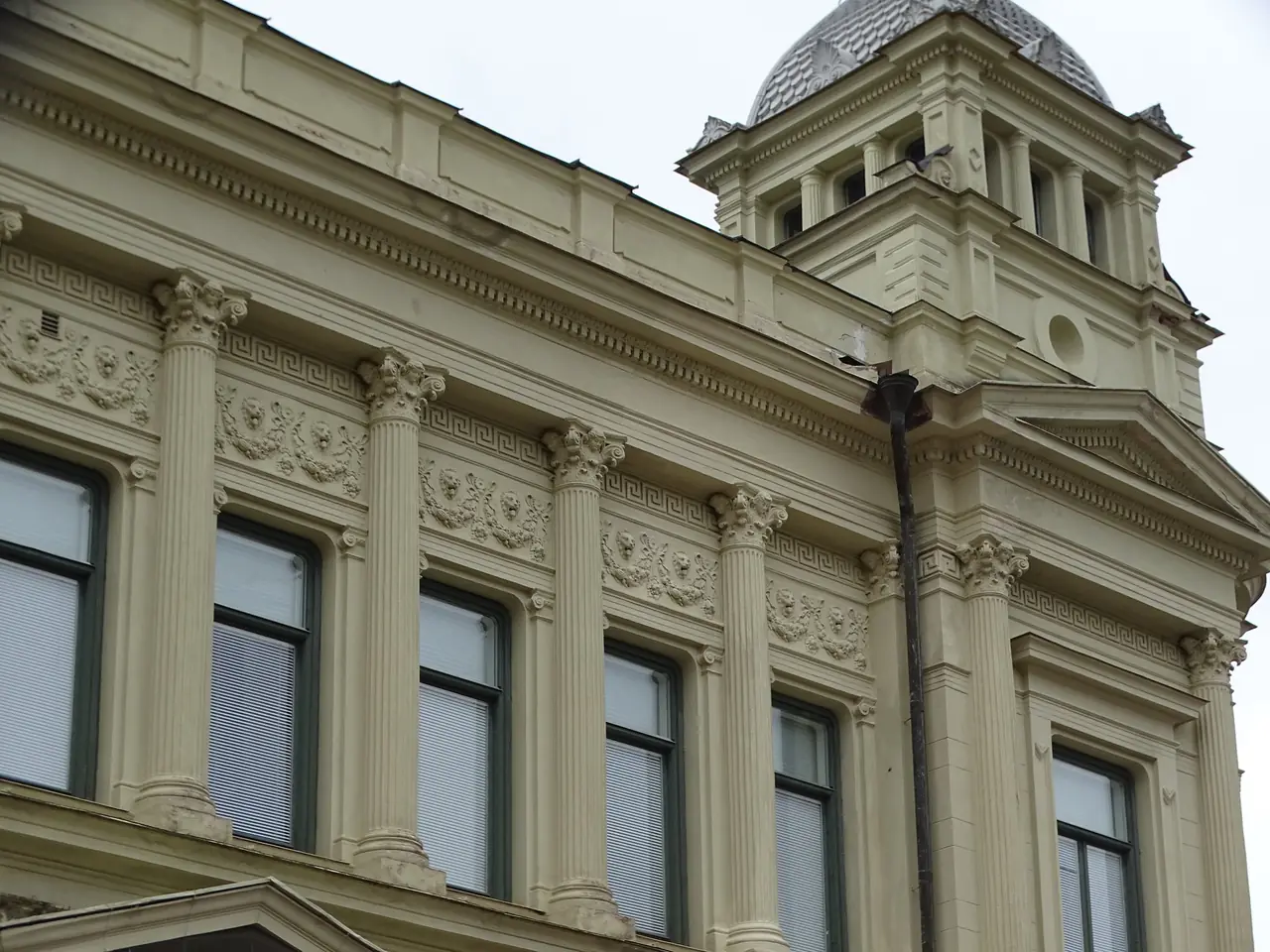
The historic Morabyrån building in Kristinehamn has a richly decorated facade with columns, Corinthian capitals, mascarons and a Greek key frieze. Over time many of its details were damaged. We describe how we approach restoration like this and what an invisible repair demands.
The building and the problem
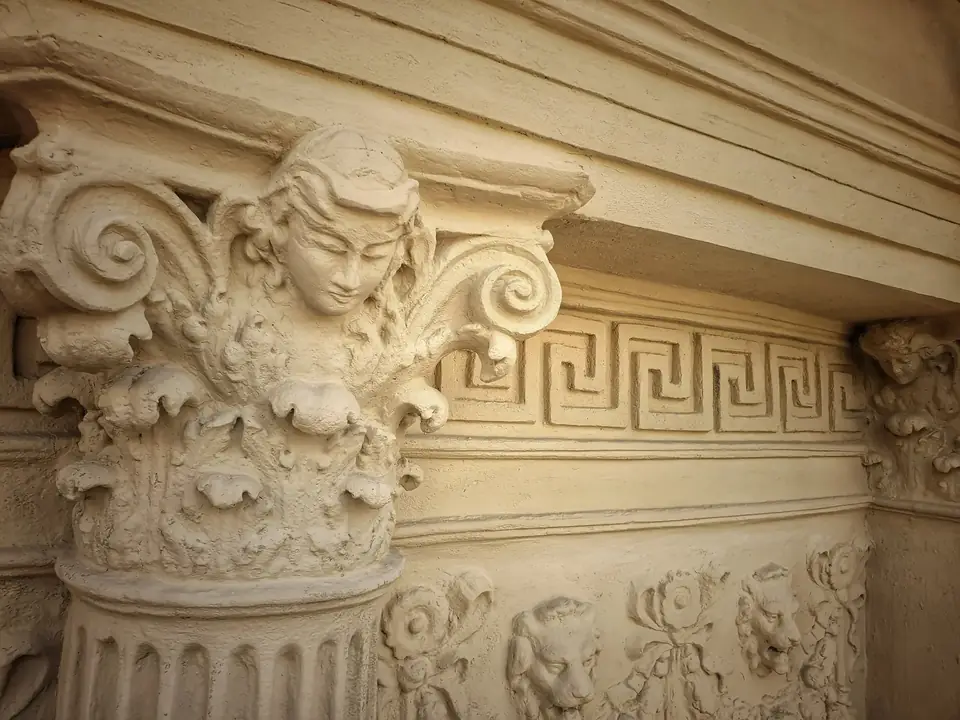
Morabyrån is one of our projects in Sweden, where the company's founder moved in 2018. The building's facade is richly ornamented: columns, Corinthian capitals, mascarons, a Greek key frieze and cornices. Details like these give an elevation its character, but they are also the most exposed to water, frost and time.
When an ornament loses fragments, the problem is not only aesthetic. The damaged area collects water, and exposed layers deteriorate faster. That is why restoring a detail should bring back both its appearance and the continuity of the surface.
It pays to plan detail restoration while the losses are still small. The longer water works on a damaged ornament, the more of the original form has to be rebuilt later, and the harder and more visible the repair becomes.
Diagnosis first
A repair starts with assessing the existing condition: the type of substrate, the materials used previously and the cause of the damage. Only then is the method chosen. Not every surface can be repaired with the same system, and the new material must be compatible with the existing structure.
Damaged or unstable areas must be prepared before new layers are applied. Depending on the situation this includes cleaning, removing weak fragments, repairing the substrate, local strengthening and re-sculpting.
In historic buildings the cause is often water running down cornices, leaking flashings, or earlier repairs made with incompatible material. If the cause is not removed, even a well-recreated detail will start to deteriorate in the same place.
Recreating the detail by hand on the scaffold
We filled in and recreated the damaged elements of Morabyrån by hand, working from scaffolding directly on the facade. The scope covered Corinthian capitals, mascarons and ornaments, friezes and cornices, filling of losses and colour matching to the elevation.
Details such as a Corinthian capital or a mascaron are sculpture, not a catalogue building component. Acanthus leaves, the features of a mascaron's face and the rhythm of a Greek key have to be recreated with a feel for proportion, light and shadow, because a facade is seen from the street, from different angles and in different light. A frieze or cornice that loses its continuity immediately disrupts the rhythm of the whole elevation.
Sculpting on site makes it possible to match the form to what has survived alongside: the depth of relief, the rhythm of the ornament, the character of the edges. A detail must not look like a new cast inserted into an old wall.
Experience that pays off in restoration
Working with architectural detail has been part of our practice since our earliest years. In Belarus we created facades for houses and commercial buildings with hand-carved stone, columns, bay windows, window surrounds and plinths. The same skill of sculpting on the wall, at full scale, is the foundation of restoring historic ornament.
In Kristinehamn we also created decorative interior finishes for The Pub 27: walls and columns in imitation old brick and stone, a portal for the wine area, and details and reliefs, all made directly on site.
Colour and the invisible repair
The goal was a repair that is invisible across the whole elevation. That requires matching not only the form but also the texture and colour to the original. Not every repair should look new: often the best one is the one you cannot see, because the repaired area belongs to its original surroundings.
That is why, after the technical work, we recreate the texture, colouring, patina and character of the earlier surface, and finally blend the colour into the rest of the elevation.
Colour is matched against the adjacent original areas, not against a swatch. An old elevation has discolouration, streaks and patina; the new section must take these on, or it will show from a distance as a bright patch.
Historic buildings: approvals and responsibility
On buildings of historic value, the scope of work, the form of recreated elements and the materials should be agreed with the owner and, where the building requires it, with the heritage authority. In our proposal for the City Park in Trzebiatów we adopted the principle that the form of any reconstruction must be based on archival sources and receive heritage approval.
If a repair reveals a structural problem, we agree the scope of that work with the client before continuing, and the assessment is entrusted to a licensed engineer. Not every restoration has to be done from scaffolding either: for a render facade repair on a residential building in Kristinehamn we worked from a cherry picker.
Questions and answers
Do you recreate missing ornaments, not just fill losses?
Yes. We recreate missing details and textures, sculpting them by hand to match the surviving fragments and the form and colour of the original.
Does restoration always need scaffolding across the whole wall?
No. Access depends on the scope and the building. We recreated the Morabyrån details from scaffolding, and repaired the render facade of another building in Kristinehamn from a cherry picker.
Do you work on listed buildings?
Yes, within the sculptural and decorative scope. We agree form and materials with the client and, where regulations require it, with the heritage authority.
More articles
Knowledge →
Do you have a complex themed or sculptural package to deliver?
Send drawings, visualisations or a short description. We review every brief and reply with a concrete next step.
Architects and general contractors: Send the project documents